
Подробный разбор по теме в нашем закрытом телеграмм канале ВЭД Логика. В чате можно задать вопрос, посоветоваться с экспертами, поделиться новостью.
New regulations aim to ensure access to, and departure from, vehicles can still be obtained after a power-cutting accident.
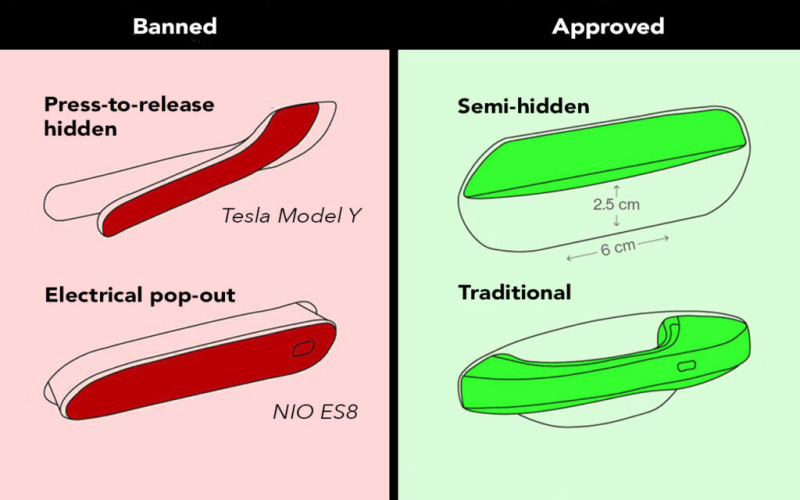
China has introduced the world’s first mandatory safety standard for automobile door handles, effectively prohibiting fully hidden door handle designs across the industry.
The Ministry of Industry and Information Technology released the new regulation “Safety Technical Requirements for Automobile Door Handles” (GB 48001-2026) on January 28, with implementation scheduled for January 1, 2027.
The standard mandates that each exterior door handle must maintain a hand-operable space of at least 60mm × 20mm × 25mm in any operational state.
This technical requirement makes China the first country globally to formally ban completely concealed door handle designs, marking a significant shift in automotive safety regulation.

Hidden handles pose rescue risks
The proliferation of hidden and electronic door handles has accelerated alongside the rapid adoption of new energy vehicles, with manufacturers favouring these designs for their aerodynamic benefits and futuristic appearance, but a series of high-profile accidents with models from Tesla and Xiaomi, among others, have raised safety concerns regarding their reliability in emergency situations.
Power system failures present the most critical risk, as fully hidden door handles depend entirely on electronic operation. During accidents involving collisions, fires, or battery thermal runaway events that cause power loss, these handles may fail to deploy, preventing external rescue personnel from accessing vehicle occupants.
Data from the China Insurance Automotive Safety Index (C-IASI) demonstrates the severity of this issue, with a 2024 crash test report revealing that vehicles equipped with purely electronically controlled hidden door handles achieved only a 67% success rate for door deployment following side-impact collisions, compared to 98% for conventional mechanical handles.
Additional operational challenges include complex activation procedures and handle freezing in low-temperature conditions, issues frequently reported by users.
Four-dimensional safety framework
The new regulation addresses these safety concerns through comprehensive technical requirements across four key areas.
Mechanical redundancy provisions require each door, excluding tailgates, to feature both mechanical exterior and interior handles, so that following deployment of irreversible restraint devices or battery thermal events, non-impact side doors will remain manually operable through mechanical means, eliminating power failure risks.
Operational space requirements specify that exterior door handles must be positioned within designated accessible zones whilst maintaining adequate hand-operable clearance, while interior handles must be intuitively visible, unobstructed by components, and located near door edges to ensure rapid emergency access.
Identification marking standards mandate that interior handles display permanent graphic symbols measuring at least 10mm × 7mm, alongside text markings with minimum 6mm height. These requirements address visibility and location identification issues at the design stage.
Structural strength specifications require exterior handles to withstand external forces of at least 500 Newtons without failure, whilst interior handles must resist 50 Newtons without detachment, ensuring continued functionality following accidents.
Industry collaboration drives standards
The China Automotive Standardisation Research Institute coordinated extensive testing during standard development, conducting joint static and dynamic evaluations on over 30 vehicle models.
Participating manufacturers included Geely, Li Auto, Xiaomi, XPeng, BYD, and Volkswagen China, ensuring technical solution feasibility across the industry.
Implementation will proceed in phases, with newly applied vehicle types for type approval required to comply from January 1, 2027.
Previously approved vehicles receive a transition period extending until January 1, 2029, allowing manufacturers time to adapt existing designs to meet the new safety requirements.